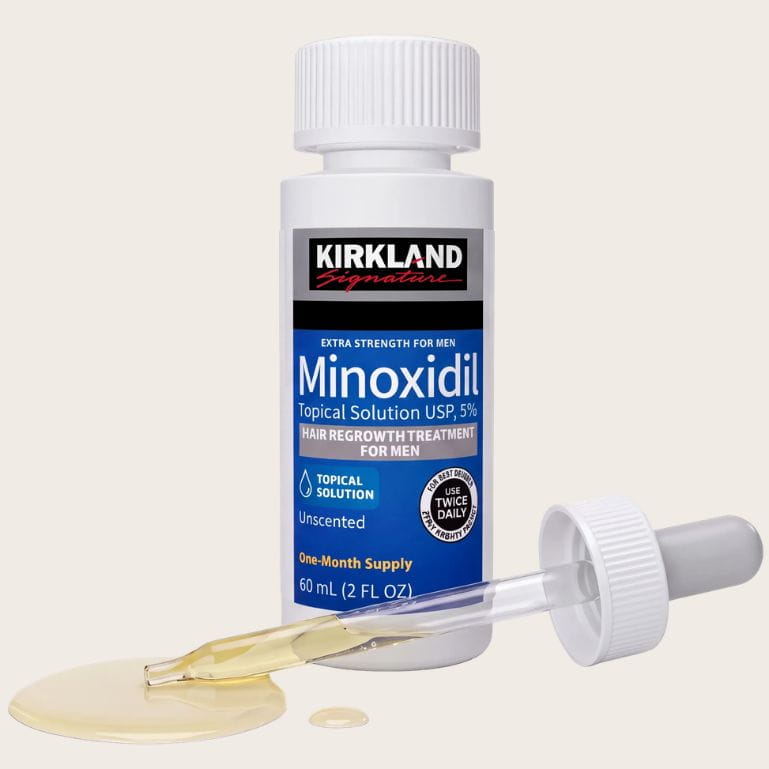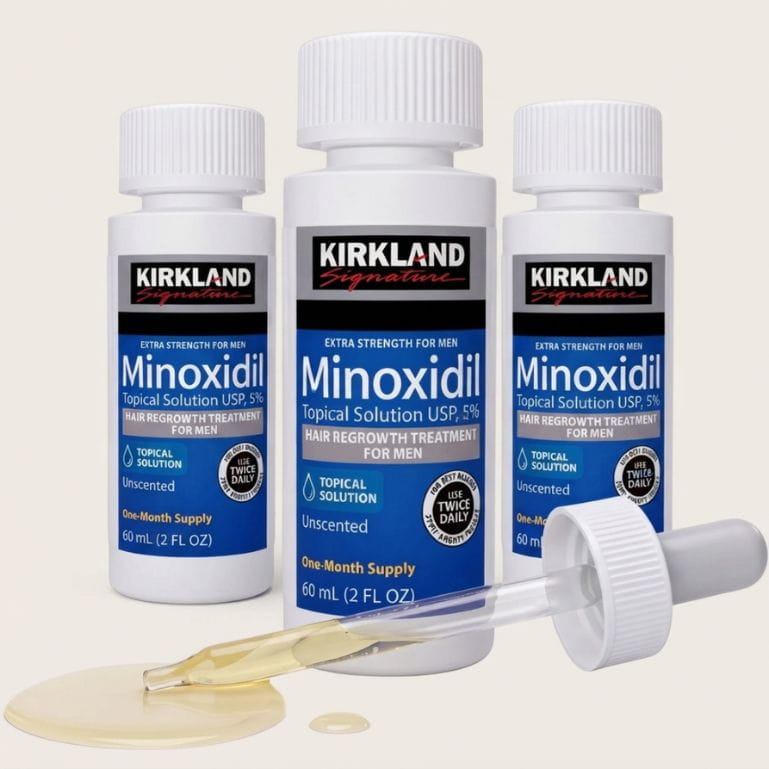
How Long Does Kirkland Minoxidil Take to Work?
Wondering when you'll actually see results? Here is the real, month-by-month hair regrowth timeline for Kirkland Minoxidil 5%—from the early shedding phase to thick, terminal hair.

The Quick Answer
According to the official label, Kirkland Minoxidil 5% can start showing results in as little as 2 months with twice-daily use. But for many men, it takes at least 4 months of strict, daily application before you spot real changes.
Your first new hairs will likely be soft, clear "peach fuzz". Also, don't panic if you see more hair falling out in the first two weeks—that is a normal sign that old hairs are making way for new growth. You have to keep using it every day to see and keep your results.
Let's be honest: regrowing hair takes time. Kirkland Minoxidil 5% is clinically proven to treat male pattern baldness (androgenetic alopecia) by stimulating hair follicles on the top of the scalp (the vertex). But it's not an overnight fix.
Your hair operates on a long, slow growth cycle. You won't see changes in a few days. This guide walks you through the exact hair regrowth timeline—month by month—so you know exactly what to expect, from the initial shedding phase to peak density.
The Science: Why Hair Regrowth Takes So Long
To understand the timeline, you must understand the human hair growth cycle. Hair follicles are not continually growing; they cycle through distinct phases:
-
1
Anagen (Growth Phase) Lasts 2 to 6 years. The hair is actively growing from the follicle.
-
2
Catagen (Transition Phase) Lasts a few weeks. The follicle shrinks and detaches from the blood supply.
-
3
Telogen (Resting & Shedding Phase) Lasts 3 to 4 months. The old hair rests and eventually falls out, making way for new Anagen growth.
How Minoxidil Actually Works
Minoxidil acts as a powerful vasodilator. When you apply the liquid to your scalp, it widens blood vessels, increasing blood flow. This delivers vital oxygen and nutrients directly to your shrunken hair follicles.
More importantly, minoxidil forces resting follicles (Telogen phase) to wake up and enter the active growth phase (Anagen phase). It then keeps them in this growth state longer, resulting in thicker, stronger terminal hair.
Month-by-Month Expectation Framework
This timeline shows typical milestones if you apply the solution twice a day. Everyone's hair responds differently, so use this as a general guide rather than a strict guarantee.
The Initial Shedding Phase
Many guys panic during this phase. You might notice more hair falling out in the shower. This is completely normal and expected.
Adjustment & Acclimation
The early shedding usually stops by the end of month one. Your scalp is getting used to the routine. You probably won't see any new hair yet, but changes are happening deep below the surface.
Early Signs (The 2-Month Mark)
The label says results can start around month two. If you respond quickly, you might spot the first signs of life along your crown.
- New hairs often appear as soft, downy "peach fuzz" (vellus hairs).
- These hairs may be colorless or lighter than your natural hair.
- They are fragile and require continued treatment to mature.
Continued Maturation
That fine peach fuzz from month two starts turning into real, terminal hair. It will slowly take on your natural hair color and get thicker. It might still be hard to notice in the mirror, but real progress is happening.
Visible Results Deadline
The official label clearly states it can take at least 4 months to see results. By the end of month four, most guys who respond well to the treatment will finally notice real, visible thicker hair on their crown.
Thickening & Density
Now the new hairs are getting thicker and longer. The bald spots on your crown should look noticeably more filled in. By now, applying the solution twice a day is just a normal part of your morning and night routine.
Peak Results & Maintenance
You will usually hit your maximum results around the one-year mark. After that, you aren't trying to grow more hair—you're just keeping what you gained.
Expectations vs. Reality
A factual comparison of common assumptions versus clinical reality based on product labeling.
| The Assumption | The Reality |
|---|---|
| "I will see thick hair in a few weeks." | Results take at least 2 to 4 months. Early growth is usually soft, downy peach fuzz, not thick terminal hair. |
| "It cures baldness forever." | There is no cure for male pattern baldness. Minoxidil is a treatment. If you stop using it, regrown hair will fall out. |
| "Applying more will speed up results." | Applying more than the recommended 1mL twice daily will NOT produce faster or better results, but it will increase the risk of side effects. |
| "It works perfectly for everyone." | Results vary. The label indicates it is for men with gradual thinning on the vertex. It is not intended for frontal baldness or a receding hairline. |
Common Local Effects
During the first few months, as your scalp adjusts to the propylene glycol and alcohol in the solution, you may experience:
- Mild scalp dryness or flaking
- Slight itching or irritation
- Temporary shedding (Weeks 1–2)
Using a moisturizing dandruff shampoo can help alleviate mild dryness.
When to Seek Medical Advice
Stop use and ask a doctor if you experience any of the following systemic side effects:
- Chest pain or rapid heartbeat
- Faintness or dizziness
- Sudden, unexplained weight gain
- Swollen hands or feet
- Severe scalp irritation that worsens
The Complete Kirkland Minoxidil
Results Timeline
Patience is everything. If you don't know how long it takes, you'll probably quit right before it starts working. Here is a clear, month-by-month breakdown of what you'll see in the mirror at each stage of your hair regrowth journey.
Before You Start
Before applying your first drop, you need to set a realistic baseline. Take photos. Your eyes are terrible at noticing gradual day-to-day changes in the mirror. A baseline photo taken under harsh lighting—pointing down at the top of your head—is the only reliable way to track your progress.
Hair only grows about half an inch per month. When dealing with thinning hair, it's even slower. Checking your hair every morning will just drive you crazy and make you want to quit. Take a photo, put the camera away, and just stick to the routine.
Keep your expectations realistic. Minoxidil isn't an overnight miracle cure. It's a proven treatment, but it requires serious patience. You are signing up for a marathon, not a sprint.
The Adaptation Period
During the first two weeks, your scalp is just getting used to the liquid. You might notice a bit of dryness, a mild tingling from the alcohol, or just slightly stiffer hair where the solution dries.
Do not expect any new hair yet. In fact, you might experience the exact opposite: early shedding. It's incredibly common and completely misunderstood.
Early shedding actually means the minoxidil is working. It wakes up your resting follicles. To push a new, healthy hair out, the follicle has to kick out the old, weak hair first. It's a sign of activation, not failure.
Whatever you do, don't panic and stop using it just because your hair looks a little thinner in week two.
The Foundation Phase
Making it to the end of month one means you've built a solid daily habit, but visually, it's pretty anticlimactic. When looking for Minoxidil results after 1 month, you probably won't see any. But beneath the surface, your follicles are working overtime to construct new hair shafts.
One month is simply too early to judge if it's working. There hasn't been enough time for new hair to break through the scalp and get long enough to actually see. Zero visible improvement right now is completely normal and expected.
At this stage, take your month 1 photo using the exact same harsh lighting and overhead angle as your baseline photograph. What consistency means at this stage is adhering strictly to the twice-daily application schedule, regardless of what you see in the mirror.
The First Signs
By the time you hit month two, the groundwork is laid. Some early responders might actually start seeing their first Minoxidil results after 2 months as new hairs finally break through the skin.
But don't expect thick, dark hair just yet. These new hairs usually show up as fine, clear "peach fuzz" (vellus hairs). You might have to squint in bright lighting just to spot them. By now, any early shedding should have stopped completely.
This is why the official label explicitly allows results to appear as early as 2 months for highly responsive individuals. But it is vital to remember why the absence of visible results at month 2 does not automatically mean failure. The vast majority of men require double this time for the follicles to generate structurally significant hair that can be easily seen.
Continued Maturation
Month three is an exciting milestone. When looking for Minoxidil results after 3 months, you should start seeing that clear peach fuzz turn into actual, terminal hair. It will start picking up your natural hair color and feeling thicker when you run your hands through it.
However, why lighting can make progress difficult to judge becomes very apparent here. In harsh bathroom lighting, your hair might still look thin as the light penetrates to the scalp, while in softer daylight or low light, the new density is obvious. This optical illusion is perfectly normal during the intermediate phases of regrowth. It is also important to understand why individual response differs greatly. Genetics, age, hormonal factors, and the overall severity of hair loss all play a massive role in how quickly you respond.
Not everyone sees massive growth by month three. Some guys will have undeniable changes, while others are just spotting their first peach fuzz. Both are completely normal.
The Clinical Deadline
Month 4 is the make-or-break checkpoint in your Kirkland Minoxidil timeline. The official product label states clearly that it can take at least 4 months to see results.
By now, if you've been applying it twice a day without failing, you should see undeniable new density on your crown. The fine hairs should now be fully colored and actively filling in your bald spots.
If you've been strict with your routine for four full months and see absolutely zero improvement, the official label suggests stopping use and talking to a doctor.
Density and Thickening
Making it past month four is usually where the magic happens. When you check your Minoxidil results after 5 months, you should see aggressive progress. Hair grows in stages, so the slower follicles are finally waking up and joining the party. Your hair will get noticeably thicker.
The hairs that started growing in month two are now long and dark, while brand new hairs are just breaking through the scalp. Don't stop now! If you quit, you'll interrupt this massive growth cycle and quickly lose all the density you just spent 5 months fighting for.
The Long-Term Checkpoint
Hitting the six-month mark is a massive achievement in patience. When looking at your Minoxidil results after 6 months, almost all of your responsive follicles are now pumping out thick, mature hair.
Your crown should look significantly denser. Your hair will feel thicker to the touch and cover your scalp much better under light. Put your baseline photo next to your month 6 photo on a large screen—the difference should be night and day.
But remember, six months doesn't guarantee a full head of hair. Kirkland Minoxidil 5% results vary wildly. Some guys get their entire crown back, while others just get enough thickening to hide their bald spot. Both are a huge win.
Maintenance
As you push toward month 12, the game changes. Because the growth phase is now artificially extended by the minoxidil, your hairs are allowed to grow longer and thicker than they have in years.
Clinical studies show that you'll usually hit your absolute peak results around the 1-year mark. But if you stop using it, those newly supported follicles will shrink right back down, and you'll lose it all.
Summary Table: What to Expect
To simplify this journey, here is a clear table outlining the Kirkland Minoxidil results timeline:
| Time | What may happen | What you may see | What not to assume | What to do |
|---|---|---|---|---|
| Weeks 1–2 | Follicles are stimulated; old hairs may be pushed out. | Possible temporary increase in shedding. | Do not assume the treatment is failing or making you bald. | Continue twice-daily application without panic. |
| Month 1 | Cellular groundwork is laid; proteins synthesized. | Usually no visible hair growth. Shedding subsides. | Do not assume the product doesn't work for you. | Take a 1-month photo; maintain strict routine. |
| Month 2 | Fast-responding follicles produce early growth. | Possible fine, soft "peach fuzz" (vellus hairs). | Do not assume absence of fuzz means failure. | Stay consistent; results are just beginning. |
| Month 3 | Vellus hairs transition into terminal hairs. | Early changes in density; hairs gaining pigment. | Do not expect full thickness or perfect coverage yet. | Compare photos using consistent lighting. |
| Month 4 | Clinical evaluation checkpoint for most users. | Visible regrowth and density improvement for responders. | Do not assume late results will magically appear if zero changes exist now. | If no results are seen, consider stopping and consulting a doctor. |
| Months 5–6 | More follicles join the Anagen growth phase. | Gradual thickening; obvious cosmetic improvement. | Do not assume you can reduce application frequency. | Celebrate progress; maintain twice-daily application. |
| 6–12 Months | Peak cosmetic improvement is achieved. | Maximum density and structural hair thickness. | Do not assume the hair is permanent and you can stop. | Continue use indefinitely to maintain all regained hair. |
Comparison
Topical Solution vs. Foam: Is the Timeline Different?
Kirkland offers both a liquid solution and an aerosol foam. Do they work at different speeds? Biologically, the timeline is exactly the same because the active ingredient (5% Minoxidil) is identical. However, there are some practical differences in how they absorb that might impact your daily routine.
Kirkland 5% Topical Solution (Liquid)
Kirkland 5% Foam
Deep Dive
Surviving the Initial Shedding Phase
The scariest part of this entire process happens between weeks 2 and 4. This is the dreaded "Minoxidil Shed." About 20–30% of guys will see noticeably more hair falling out. If you understand why this happens, you won't panic and quit right when the treatment is actually starting to work.
When you apply minoxidil, it wakes up your scalp. Resting follicles are suddenly kicked into high gear. But a follicle can't grow a brand new hair if the old, dead one is still stuck in the pore. It has to physically eject the old hair to clear a path for the new one.
Therefore, the shedding you experience is actually a positive biological indicator that the medication is successfully stimulating your follicles. It means the old, miniaturized hairs are being evicted to make room for stronger, healthier hairs.
How long will the shedding last?
The shedding typically begins around week 2 and can last for 2 to 4 weeks. By the end of month 1, the excessive shedding should completely subside. If you experience severe shedding that continues beyond 2 months, stop use and consult a dermatologist, as you may be suffering from an unrelated condition like Telogen Effluvium induced by a different stressor.
Application
Maximizing Absorption: Are You Applying It Correctly?
The timeline heavily depends on correct application. Kirkland Signature Minoxidil 5% Topical Solution must be absorbed by the scalp to reach the hair follicles. If you apply it incorrectly, much of the medication is wasted on the hair shaft where it does nothing.
The Optimal Application Routine
The medication cannot penetrate a thick layer of sebum (oil) or sweat. Ensure your scalp is clean. More importantly, it must be completely dry. Applying minoxidil to a wet scalp dilutes the solution and prevents the propylene glycol from carrying the active ingredient into the dermis.
Use a comb or your fingers to part your hair, exposing the skin on the vertex (crown). The goal is to get the liquid directly onto the scalp skin, not the surrounding hair.
Use the provided dropper to draw exactly 1mL of the solution. Apply it drop by drop along the parted lines on the vertex. Gently rub it in with your fingertips.
Clinical data indicates that it takes approximately 4 hours for the maximum amount of minoxidil to be absorbed into the scalp. Do not wash your hair, go swimming, or sweat profusely during this 4-hour window.
Biology
External Factors That Influence Your Timeline
While the official label states results can take 2 to 4 months, your individual biological environment dictates how efficiently the follicles respond. Topical minoxidil is a catalyst, but your body must provide the building blocks to construct new hair.
Hair is primarily composed of a protein called keratin. If your diet is severely lacking in protein, iron, Vitamin D, or zinc, the forced Anagen growth phase triggered by minoxidil will be sluggish.
High cortisol levels push hair follicles prematurely into the Telogen (shedding) phase, a condition known as Telogen Effluvium. This directly fights against minoxidil's mechanism of action.
Minoxidil does not block Dihydrotestosterone (DHT), the hormone responsible for male pattern baldness. Men with extremely aggressive DHT sensitivity may see slower visible results.
FAQ
Frequently Asked Questions
Can I speed up the results by using it 3 times a day?
No. The FDA-approved labeling strictly advises applying 1mL two times a day. Applying more often or using larger amounts will not improve results and may increase the risk of systemic side effects.
What if I miss a dose? Will I lose my progress?
Missing a single dose will not destroy your progress. If you miss a dose, simply skip it and return to your normal twice-daily schedule. Do not double the dose to "make up" for a missed application.
Does it work on a receding hairline?
Kirkland Signature Minoxidil 5% is officially labeled for men who have a general thinning of hair on the top of the scalp (vertex). It is not intended for frontal baldness or a receding hairline, as clinical trials predominantly tested efficacy on the vertex.
Can I style my hair after applying it?
Yes, but you must allow the solution to dry completely on your scalp first. Applying styling gels, pomades, or sprays while the scalp is still wet can dilute the medication and reduce its absorption.
Can I use derma rolling (microneedling) with Kirkland Minoxidil to speed up the timeline?
While studies have shown that microneedling can significantly enhance the absorption and efficacy of topical minoxidil, it is not part of the official labeling. If you choose to derma roll, dermatologists generally recommend waiting 24 hours after rolling before applying minoxidil to prevent the medication from entering the bloodstream too rapidly and causing systemic side effects.
Will it work if I only apply it once a day?
The half-life of topical minoxidil on the scalp is roughly 22 hours. However, the official labeling and clinical trials that guarantee the 2–4 month timeline are based strictly on a twice-daily (every 12 hours) application schedule. Applying it once a day may yield results, but the timeline will likely be extended, and the total density achieved may be lower.
Can I use Kirkland Minoxidil on my beard?
Kirkland Signature Minoxidil 5% is strictly labeled for use on the vertex of the scalp. It is not FDA-approved for facial hair growth. The skin on the face is much thinner and more sensitive than the scalp, meaning systemic absorption—and the risk of side effects like heart palpitations and severe dryness—is significantly higher.
What happens if I stop using it after 6 months?
If you stop using minoxidil after achieving results, the artificially prolonged Anagen phase will end. Within 3 to 4 months of stopping, all the hair you regrew will shed, and your hair loss will revert to the state it would have been in had you never started the treatment. Minoxidil requires a lifelong commitment to maintain results.
Does Minoxidil work better when combined with Finasteride?
Yes. Minoxidil and Finasteride work via two completely different mechanisms. Minoxidil acts as a growth stimulant (a fertilizer), while Finasteride acts as a DHT blocker (a shield). Clinical studies consistently show that using both treatments simultaneously yields significantly better and faster results than using either one alone. However, Finasteride requires a prescription from a doctor.
How to Tell If Kirkland Minoxidil Is Working
Look for Real Regrowth Signals
The biggest source of anxiety during treatment is constantly wondering, "Is minoxidil actually working?" Because hair grows so slowly, it's easy to second-guess yourself. But if you know what real progress looks like, you won't lose your mind staring in the mirror.
First, accept that you will never see minoxidil progress in the mirror day-to-day. Hair only grows half an inch a month. Because the changes happen so slowly beneath the skin, the difference between "it's working" and "nothing is happening" looks exactly the same on a random Tuesday. The only reliable way to track Kirkland minoxidil results is by taking monthly photos.
What Early Signs of Response May Look Like
The first signs minoxidil is working aren't dramatic at all. Most early responders just spot fine, soft, clear hairs around their bald spots around the 8-to-10 week mark. They look nothing like your normal hair. You might miss them entirely unless you're squinting under a bright light.
Over the next few months, that clear fuzz slowly turns into real hair. It gets darker and thicker. This is what minoxidil before and after photos are actually capturing: weak, dead hair being slowly replaced by strong, visible hair.
You might also just feel it. A lot of guys say their crown feels slightly less bald when they run their fingers through their hair, weeks before they actually see a difference in the mirror.
Why Day-to-Day Observation Is Unreliable
Hair changes so slowly that your brain literally cannot process the difference day-to-day. You aren't crazy, you're just looking at it way too often.
Bathroom lighting is your worst enemy. Bright overhead lights shine directly down through your hair, making your bald spots look ten times worse than they actually do in normal daylight. If you only check your progress in the bathroom mirror, you will always feel like you're losing.
Hair length messes with your head. If you get a short haircut in month 3, your hair will instantly look thinner under bright light, even if the minoxidil is working perfectly. Always keep your haircut in mind when comparing photos.
One side might grow faster. Hair loss is rarely perfectly even, and neither is hair growth. If the left side of your crown fills in before the right side, don't panic. That's just how the biology works.
Everyone is different. Two guys who start minoxidil on the exact same day could have totally different results by month 4. Don't compare yourself to people on Reddit. Just stick to your own routine.
Reduced Shedding Is Not the Same as Regrowth
Noticing less hair in the shower drain is a great sign—it means your hair loss is stabilizing. But stopping hair loss isn't the same thing as growing new hair. The goal is to do both.
Practical Monthly Tracking Method
Take 2–3 photographs under identical harsh overhead lighting. Capture the vertex from directly above, and both sides. Note your hair length. Save these photographs somewhere permanent. This is your only objective reference point for the entire treatment.
Repeat the exact same photographs. Do not expect visible change. Record any observations about scalp sensation, shedding levels, or comfort with the application routine. Do not make any conclusions about effectiveness.
Place your month 0 and month 2 photographs side-by-side on a screen. Look for any fine, soft hairs in the thinning zone that were not visible before. Inspect under the same lighting the photographs were taken in, not in your bathroom mirror.
Compare month 3 to month 0, not to month 2. Short intervals make change invisible. Look specifically at scalp visibility — can you see less scalp through the hair in the vertex area? Note whether any early vellus hairs from month 2 have gained pigment or thickness.
This is the clinical checkpoint. Compare month 4 to month 0. If there is zero detectable change in coverage, density, or the presence of any new hair growth — and you have been strictly compliant — the official labeling suggests consulting a doctor about whether to continue. If you see any measurable progress, continue.
For those seeing progress, this is a period of compounding results. More follicles are joining the growth phase. Continue photographing. Changes should now be more obvious when comparing to your month 0 baseline.
Place your month 6 photograph next to your month 0 photograph on a large screen. The difference in scalp coverage should be clearly visible for most responders. This six-month comparison is the most reliable self-assessment you can perform. Peak improvement continues through month 9–12.
Signs You May Be Seeing Progress
- • Soft, fine, colorless or lightly pigmented hairs appearing in the thinning zone
- • Those early fine hairs gaining thickness and pigment over subsequent months
- • Reduced visible scalp when comparing month 4–6 photos to month 0
- • Tactile sensation of increased hair density when running fingers through the vertex
- • Others noticing improvement before you do
- • Gradual stabilisation of the thinning area — no continued loss
Things That Do NOT Automatically Mean It Is Working
- • Hair shedding during the first 1–2 weeks (this can occur regardless of whether regrowth follows)
- • Your scalp feeling tingly or slightly irritated
- • Hair looking slightly fuller immediately after application (wet solution adds volume temporarily)
- • Reduced shedding alone, without visible new terminal hair growth
- • Scalp feeling less dry or flaky after the first month
Things That Do NOT Automatically Mean It Is Failing
- • Seeing no visible change at month 1 or 2
- • One side of the scalp appearing to respond faster than the other
- • Your hair looking thin under harsh overhead bathroom lighting
- • New hairs appearing colorless or lighter than your natural hair
- • Progress being slower than someone else's before and after photos online
- • Feeling like nothing has changed when comparing photos taken one week apart
Kirkland Minoxidil Shedding: What the Label Actually Says
Understanding Early Hair Loss After Starting Minoxidil 5%
One of the most unsettling experiences for people who have just started treatment is noticing what appears to be accelerated hair loss after starting minoxidil. This causes a significant number of users to stop treatment prematurely — sometimes just weeks before they would have seen results. Understanding what the official labeling says, what is biologically possible, and what falls outside the expected range is critical for making an informed decision.
What the Kirkland Minoxidil Consumer Label States
According to the Kirkland Signature Minoxidil 5% Topical Solution consumer labeling, hair loss may temporarily increase for up to two weeks after beginning treatment. The label describes this as temporary. It does not describe this as universal, inevitable, or proof that the treatment is effective.
Does Kirkland Minoxidil cause shedding?
The label acknowledges that a temporary increase in hair loss may occur after starting the 5% solution. It does not state that all users will experience this, nor does it state it as a certainty. Minoxidil shedding is a possible early response, not a guaranteed one. Some users report no noticeable change in shedding at all during the first weeks of treatment.
Why can hair loss appear worse after starting?
The biological mechanism proposed is that minoxidil may accelerate the transition of hairs already in the resting (Telogen) phase into the shedding stage, while simultaneously pushing follicles toward active growth (Anagen). Because the resting hairs are already destined to fall, this process may temporarily increase the rate at which they exit. However, it is important to note that this explanation is based on the proposed mechanism of action — minoxidil initial shedding has not been proven to be a reliable indicator that regrowth will follow for any individual person.
When can shedding happen, and how long can it last?
Based on the label, a temporary increase in shedding after minoxidil may occur within the first two weeks of starting treatment. The label characterises the increase as lasting up to two weeks. In clinical practice, some users report the increased shedding subsiding by the end of the first month as the scalp adjusts. If increased hair fall continues significantly beyond this window, that warrants a different evaluation — not continued reassurance that it is normal.
Does shedding mean Kirkland Minoxidil is working?
No single symptom can confirm that minoxidil is working. Early shedding is listed as a possible early occurrence in the label, but it is not described as a sign of effectiveness. Whether or not you shed in the first two weeks has no established predictive value for your eventual outcome. Minoxidil makes hair fall out in some users early on — but so does the underlying androgenetic alopecia that existed before treatment began. The only reliable indicators of effectiveness are documented, objective improvements in hair coverage over months of consistent treatment, measured through photographs taken under identical conditions.
Should someone stop using minoxidil because of shedding?
The label does not advise stopping treatment because of an early, temporary increase in hair loss. If shedding occurs within the first two weeks and remains temporary, the label's guidance is to continue use. Stopping treatment in response to expected early shedding is the most common reason users abandon the treatment before any meaningful biological progress can occur. However, this only applies to mild, temporary, diffuse shedding without other symptoms. See below for situations that require a different response.
What if shedding continues beyond the expected window?
If increased hair loss continues well beyond the first month — or if shedding is severe, sudden, patchy, painful, or accompanied by scalp inflammation — this is outside the scope of the temporary response described in the label. Persistent or unusual hair loss may have causes entirely unrelated to minoxidil or to ordinary androgenetic alopecia. These include alopecia areata, scalp infections, hormonal conditions, nutritional deficiencies, or other medical causes. In these cases, the appropriate step is to stop use and consult a doctor or dermatologist for evaluation.
Symptom Reference: Expected vs. Needs Medical Review
| Symptom | Possible meaning | What to do |
|---|---|---|
| Mild, diffuse increase in shedding within the first 1–2 weeks | Possible temporary response described in the label | Continue use as directed; monitor |
| Shedding that stops and stabilises by end of month 1 | Consistent with the label's description of temporary increase | Continue use; photograph monthly |
| Shedding that continues heavily beyond 2 months | Outside the expected window; possible unrelated cause | Stop use; consult a doctor |
| Patchy hair loss in defined circular or irregular areas | May indicate alopecia areata or another condition unrelated to minoxidil | Stop use; consult a dermatologist |
| Sudden, rapid, or severe hair loss across the scalp | Not characteristic of ordinary androgenetic alopecia response; may indicate systemic cause | Stop use; seek medical evaluation |
| Scalp pain, burning, significant inflammation, or open sores | Possible allergic reaction, irritant reaction, or infection — not an expected minoxidil response | Stop use immediately; consult a doctor |
| Chest pain, dizziness, rapid heartbeat, swollen hands or feet | Possible systemic absorption — a serious adverse event listed in the label | Stop use immediately; seek urgent medical attention |
The key distinction
The label's reference to temporary early shedding applies specifically to mild, diffuse hair loss that resolves within a short window in someone who is experiencing ordinary androgenetic alopecia. It does not apply to severe, sudden, patchy, painful, or prolonged hair loss. If your experience does not match the mild, short-lived description, the appropriate course is not to persist through it — it is to stop use and get a clinical evaluation.
Choose the Supply That Fits Your Routine
These are purchasing and convenience descriptions — not medical recommendations. A longer supply does not make minoxidil work faster. It simply provides more product for maintaining the routine and reduces how often you need to reorder.
| Supply | What it contains | Best for | Price | Reordering |
|---|---|---|---|---|
| 1 Month | 2 × 60ml bottles | Starting out / first purchase | $19.99 ($19.99/mo) | Monthly |
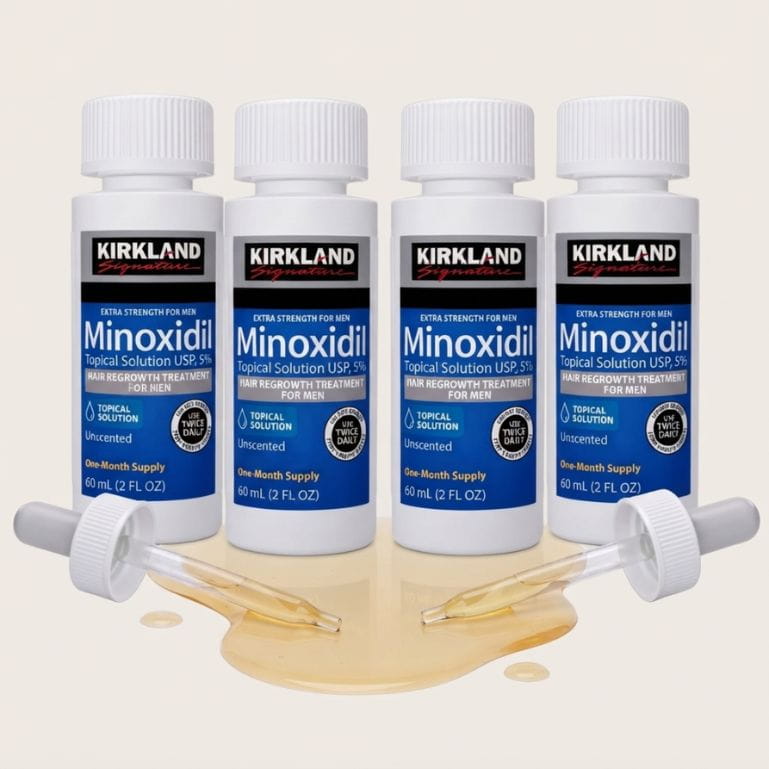
| 2 Month | 4 × 60ml bottles | Planning a couple of months ahead | $36.99 ($18.50/mo) | Every 2 months |
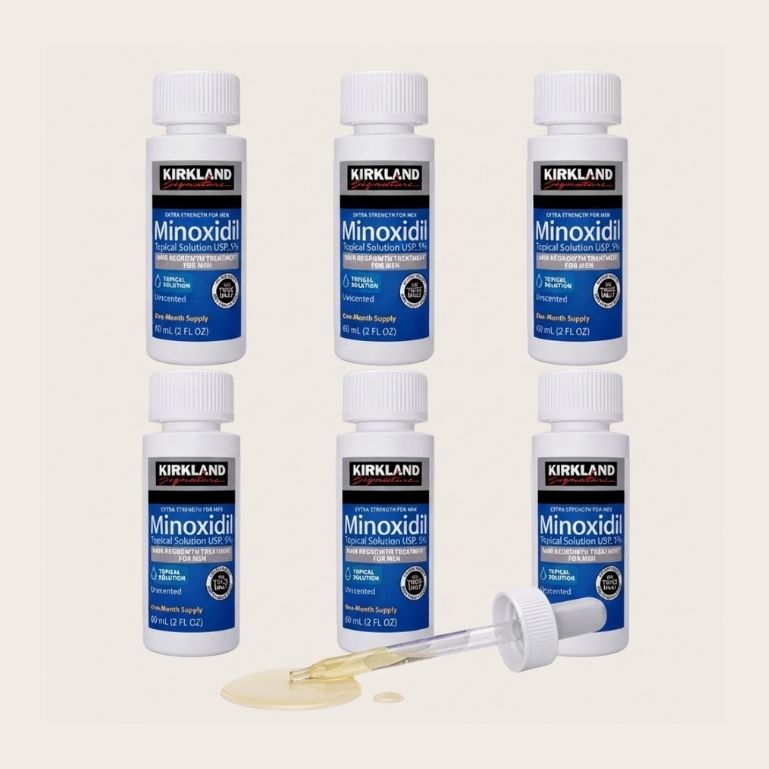
| 3 Month | 6 × 60ml bottles | Fewer reorders across a quarter | $54.99 ($18.33/mo) | Every 3 months |
| 4 Month | 8 × 60ml bottles | Planning through the 4-month evaluation point | $72.99 ($18.25/mo) | Every 4 months |
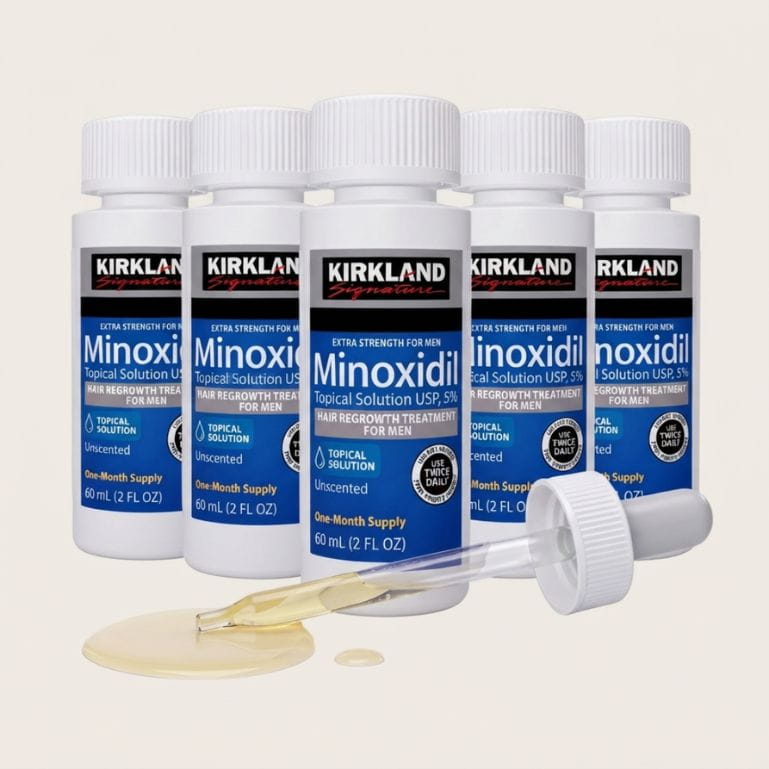
| 5 Month | 10 × 60ml bottles | Planning a longer routine with fewer reorders | $34.99.99 ($18.00/mo) | Every 5 months |
| 6 Month | 12 × 60ml bottles | Fewest reorders — longest supply | $99.99 ($16.67/mo) | Every 6 months |
Why Kirkland Minoxidil Results Are Different for Everyone
The Same Bottle. Different Outcomes. Here Is Why.
Two men can start Kirkland Signature Minoxidil 5% on the same day, follow the same twice-daily application schedule, and reach month four with completely different outcomes. One may see clear density improvement on the vertex. The other may see little visible change. Neither result is abnormal in isolation — and neither was guaranteed in advance. Understanding why individual response varies this widely is important for setting realistic expectations and evaluating your own progress honestly.
The factors below do not predict your result. They help explain why the range of outcomes across users is so wide, and why comparing your experience to someone else's timeline is rarely informative.
Younger follicles that have been miniaturizing for a shorter time may retain more biological capacity to respond. Older follicles with longer histories of miniaturization may produce a less pronounced response. Age alone does not determine outcome, but it is one of many variables in the picture.
How sensitively your follicles respond to the vasodilatory effect of minoxidil is influenced by genetics. The same concentration of active ingredient does not produce the same follicular response in every individual. This is a biological reality, not a product defect.
A follicle that has been miniaturizing for two years is in a different biological state than one that has been miniaturizing for ten. Longer duration generally means more advanced follicular change, which may affect how well or how quickly a follicle responds to treatment.
Miniaturization is the progressive shrinking of the hair follicle and its output. Follicles at early stages of miniaturization retain more structural capacity than those that have been severely miniaturized over many years. The degree of miniaturization across the thinning area affects the potential scale of visible response.
The Kirkland Signature Minoxidil 5% label states the product is intended for men with gradual thinning on the top of the scalp (vertex). The label explicitly states it is not intended for frontal baldness or a receding hairline. Users whose hair loss pattern matches the labeled indication are more likely to be using the product within the scope for which it was clinically evaluated.
Minoxidil is evaluated for androgenetic alopecia — the most common cause of male pattern hair loss. If thinning is caused by a different condition (alopecia areata, nutritional deficiency, thyroid disorder, medication side effect, or scalp disease), minoxidil is not formulated to address that cause. Misidentifying the cause of hair loss is a significant factor in uneven outcomes.
Chronic scalp inflammation, seborrheic dermatitis, psoriasis, or heavy product buildup can impair absorption of the topical solution. The active ingredient needs to reach the dermis and the follicle to have any effect. A compromised scalp environment reduces the drug's access to the target tissue.
The clinical evidence supporting the 2–4 month result timeline is based on strict, twice-daily application of the correct 1mL dose to a dry scalp. Missing doses, applying to wet hair, washing too soon, or applying incorrectly reduces the amount of active ingredient that actually reaches the follicle — and extends or eliminates the timeline.
Why Person A May See Results Earlier
Someone who starts treatment early — when follicular miniaturization is still mild and the thinning is confined to the vertex — is using the product within the labeled indication, at a stage where the follicles retain more capacity to respond. If they are also applying the product correctly twice daily to a clean, dry scalp, not washing it off within four hours, and have no significant nutritional deficiencies or scalp conditions interfering with absorption, they have optimised every variable within their control. This does not guarantee a result, but it does remove the controllable barriers to one.
Why Person B May Need More Time
Someone who has been experiencing hair loss for many years, whose follicles are more extensively miniaturized, and whose thinning pattern extends to areas beyond the labeled vertex indication may face a higher biological threshold before any visible response occurs — if one occurs at all. Added factors such as irregular application, washing the solution off too early, or an underlying scalp condition reducing absorption can further delay or diminish any detectable result. None of these factors were visible when starting treatment, which is part of why individual outcomes are difficult to predict.
Why Comparing Your Results to Someone Else Is Misleading
Before-and-after photographs shared online represent the experiences of self-selected individuals — typically those with the most dramatic results, who are motivated to share them. They do not represent average outcomes, and they provide no information about the factors that produced those results: starting age, duration of hair loss, degree of miniaturization, application consistency, or whether the individual's hair loss pattern matched the labeled indication. Using another person's result as a benchmark for your own treatment is not a clinically meaningful comparison. It is a common cause of premature, unnecessary treatment abandonment.
What You Can Actually Control
The biological factors that determine your individual response are largely fixed. The variables below are within your control. Optimising them does not guarantee a result — but failing to manage them guarantees that any potential result is compromised.
Do not skip doses. Do not apply more to accelerate results. Consistency over months is the only application variable with clinical backing.
Wet hair dilutes the solution and impairs absorption. Scalp buildup blocks penetration. A clean, dry scalp is the correct application surface.
The label indicates approximately 4 hours for maximum absorption. Washing the solution off early reduces the effective dose delivered to the follicle.
Day-to-day observation under bathroom lighting is not a reliable assessment method. Structured monthly photography under consistent conditions is.
If there is zero objective evidence of any change after four months of strict, twice-daily use, the label advises consulting a doctor. Continuing indefinitely without any evidence of response is not recommended practice.
Kirkland Minoxidil 5% is evaluated for gradual thinning on the vertex. If your primary concern is a receding hairline or frontal area, the label does not describe that as the intended use. A dermatologist can confirm whether your pattern matches the product's indication.
Patchy loss, sudden rapid shedding, scalp pain, inflammation, or any systemic symptoms should be evaluated by a doctor — not managed with continued self-treatment.
Conclusion
The Bottom Line
The answer to "how long does Kirkland minoxidil take to work?" is clinically defined: you must commit to a minimum of 2 to 4 months of strict, twice-daily application to see visible changes. The journey requires enduring a potential 2-week shedding phase, maintaining consistent application, and managing your expectations.
Patience is not just a virtue in hair regrowth; it is a biological requirement.
Ready to Start Your Routine?
Minoxidil results take time, and consistency matters more than which supply size you choose. If you are looking for Kirkland Minoxidil 5%, explore the available options and choose the amount that fits your routine.